What the Form Can Actually Prove
A family opening your inquiry form only tells you one thing. They opened the form. It doesn't mean they're urgent, it doesn't mean they're ready to book, and it doesn't mean they know what type of care they need. A form open is a real signal, but it's a small one. The trouble starts when the system treats that tiny signal like a full story.
For senior care and assisted living homes, that can get messy fast. A daughter may open the form because she's worried about her parent but not ready to talk. A spouse may start an inquiry and stop because the questions they're being asked feel too personal. A family may click through after midnight because they need help soon, or because they finally had a quiet moment to research options. The same action can come from very different situations.
Connected Data Still Needs Judgment
HubSpot talks about connected customer data across marketing, sales, and service. That idea matters because families don't move through a neat funnel. They may read a care page, open a form, call later, reply to an email, and ask a service question before anyone has a full picture of what they need.
Connected data can help your team see more of that journey instead of treating each touchpoint like a separate event. But more data doesn't exactly equate to better decision making. If the system can't tell the difference between what actually happened and what it guessed, connected data can make the wrong story look more convincing. That's why lead labels need evidence behind them. "Urgent lead" sounds useful until you ask why the system gave it that label. Did the family say they needed care this week, or did they just open the form twice? Did someone confirm they want an assessment, or did the system infer that from a page visit?
Use Three Evidence Buckets
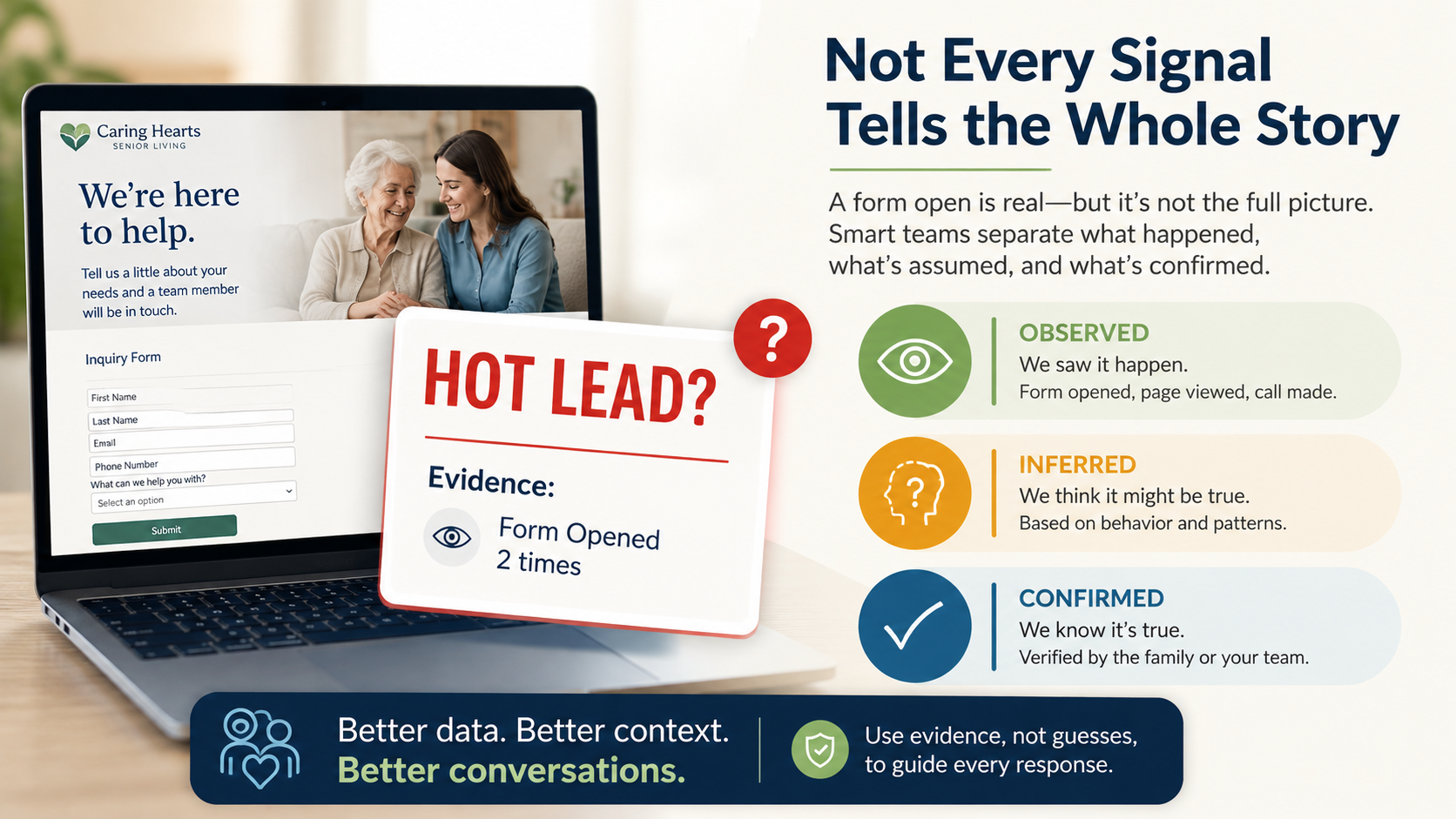
A simple way to keep this clean is to separate every signal into observed, inferred, and confirmed. Observed means your system actually saw it happen. The family opened the form, clicked the care options page, submitted a request, called the number, or replied to a message. These are real events, but they don't explain motivation by themselves.
Inferred means the system thinks something might be true based on behavior. If someone visits a memory care page three times, the system may infer that memory care is relevant. If someone opens a form after business hours, it may infer a higher level of urgency. Those guesses can be useful for routing, but they should still look like guesses.
Confirmed means the family told you or your team verified it. The caller said they need help after a fall. A staff member confirmed the family wants pricing. Someone verified the care type, location, timeline, budget fit, or decision-maker. Confirmed information is the safest foundation for customer-facing messages due to the fact that it came from a person or a real conversation.
Why The Difference Matters
The difference between inferred and confirmed may sound small, but it changes how your agency responds. If someone opens an inquiry form and views a pricing page, your system might infer that cost is important. That doesn't mean your first message should assume price is their main concern. They may be checking for a parent, comparing options for later, or trying to understand whether your agency is even in range.
The same thing happens with urgency. A late-night form start may deserve attention, but it isn't proof of an emergency. A family might be panicked, or they might be researching after work. If the system treats every late-night action like a crisis, your team can waste time chasing the wrong tone. If it ignores the signal entirely, you may miss someone who really does need fast help.
This is why the label should always carry its evidence with it. A good system doesn't just say "hot lead." It shows what made the lead look active, what is still uncertain, and what would need to be confirmed before someone sends a specific message.
Where an Agent Helps
An agent can help you save time and stress by capturing signals and flagging missing context before your team responds.
It can record that a family opened the form, viewed a service page, submitted part of an inquiry, or asked a question. It can also point out when a label depends on inference instead of confirmed information. That gives your team a better starting point without pretending the system knows more than it does.
The important boundary is the customer-facing message. If a family hasn't confirmed their care need, timeline, or urgency, the message shouldn't talk like those facts are known. It can acknowledge the inquiry and make the next step easy, but it shouldn't assume the family is ready to book or push them toward a care path they haven't described.
The Takeaway
The main goal is to stop treating a guess like a fact. Connected customer data can help your agency see the path from marketing to sales to service, but the labels inside that path need discipline. Observed signals show what happened. Inferred signals suggest what might be true. Confirmed signals tell your team what the family actually said or what someone verified.
Pick one lead label today and check what evidence is behind it. If the label is based on a real event, keep it honest. If it's based on a guess, mark it that way. If it's going to shape what your team says to a family, make sure the information is confirmed first.